Press
Media Coverage.
Where Mitzpe analysis has been cited, excerpted, and republished in the press — distinct from the institute's own coverage areas. What follows is an ongoing record.
Cited and covered
Where the Analysis Has Been Picked Up.
Other writers and newsrooms citing Mitzpe's work — quoting it, arguing with it, or sending their readers to it. Their bylines, not ours.
The freshest and most disruptive thinking I have seen about Israel advocacy.
Zehavi's argument deserves serious attention because it explains trends that simpler narratives cannot.
20267 pieces
- Episode 19: Life in Judea with Uriel Zehavi
Listen on Apple Podcasts or Spotify
Adam gives Zehavi seventy minutes on the route from progressive American writer to convert, analyst, and advocate — the essay that turned his career, building Israel Brief to readers in nearly a hundred countries, and then Judea and Samaria at length: the history, the strategic case, the legal disputes, and what daily life there actually looks like.
- Farmers Who Supported Trump Reportedly on the Verge of Losing Billions as Iran War Enters Seventh Month
IBTimes UK's report on the farm economy in the seventh month of the Iran war quotes Uri Zehavi on why the pressure on American growers kept building: shipping disrupted through the Strait of Hormuz and the transport costs that came with it, made worse by how heavily the United States leans on imported urea fertiliser.
- Farmers who backed Trump are on pace to lose $31 billion amid his Iran war — 'the worst financial downturn since the 1980s'
MoneyWise's report on the $31 billion the American farm sector is on course to lose quotes Uri Zehavi four times. Hormuz transit costs and the half of America's urea that arrives by sea are part of it — but the line he closes on is that interest has risen faster than either since 2020, and it does not fall when the Strait reopens.
- Your Daily Phil: Antisemitism czars at WJC confab in Geneva press for government action
eJewishPhilanthropy's Your Daily Phil newsletter made Israel Brief its Worthy Reads pick, quoting our argument that "right-wing" in Israel is not a single dial and does not mean what an American listener hears, and sending readers to the full brief.
- In a divided world, Israel needs a new hasbara playbook
Also ran in Israel Behind the News, Misgav Institute, David M. Weinberg, Israel Hayom, and JDN
Column by David M. Weinberg, managing senior fellow at the Misgav Institute, calling Zehavi's essay “the freshest and most disruptive thinking I have seen about Israel advocacy.”
- US politics – not Netanyahu – broke bipartisan support for Israel
Also ran in Nuevo Mundo
Featured post by David E. Bernstein, professor of constitutional law at Antonin Scalia Law School, George Mason University, engaging Zehavi's “Two Middles” dossier at length and recommending it in full.
- Hamas, The Global Intifada & What We Refuse To See
Nancy Hartevelt Kobrin, a psychoanalyst who writes on terrorism, opens her post on Rooted Truth — she calls the legal and historical work disciplined and necessary, says the book deserves wide readership, and then builds her own argument on top of it.
Written for other titles
Uri Zehavi, Elsewhere.
Pieces written for outlets outside Mitzpe and published there first. Not coverage of the institute, and not a reprint of anything that ran here — separate arguments, made in front of other readerships.
202624 pieces
- A Hormuz deal leaves Iran its uranium
Trump told reporters he’d fight the Iran war all over again because Iran can’t have a nuclear weapon. Israel’s security establishment has briefed three ways this ends, and the one to watch is limited strikes sliding into a deal that reopens the Strait of Hormuz and stops there. That leaves Iran holding 440.9 kilograms of uranium enriched to 60 percent, about nine bombs’ worth on the usual estimate. The piece argues Washington should make shipping out or diluting that stock the price of opening the strait, and Jerusalem should say so before the new Congress sits on January 3.
- Eisenkot Gets the Names While Netanyahu Keeps the Chair
The results are official: 5,717,397 votes and the same 53, 48 and 19. By Thursday Ra’am had named Eisenkot, United Torah Judaism had named nobody, and Netanyahu was down to 46. The piece goes through what the 67 recommending Eisenkot can do together, which is replace the Knesset speaker, the 49-46 version that needs seven Haredi votes to stay out of the no column, and why Netanyahu stays prime minister until somebody wins that vote.
- Netanyahu’s Only 61 Runs Through Ra’am
Israel’s elections committee finished the count overnight on Thursday: 53 seats to Netanyahu’s side, 48 to Gadi Eisenkot’s and 19 to the Arab lists, with Ra’am up to eight. Keep the two camps as they ran, add one Arab list, and only Netanyahu’s gets to 61. That same Thursday, Likud called the vote-buying and foreign-money probes “Ra’amgate” and said no Zionist party may work with Ra’am. The piece argues Likud has ruled out the only 61 its own camp could build, while Eisenkot’s side works on a 41-seat minority government and the Knesset, where the parties against Netanyahu hold 67, may matter more than the government for a while.
- Why Israel’s Election Is Deadlocked, and Where It Could Be Headed
Channel 12’s exit poll on Tuesday night had Gadi Eisenkot’s camp ahead, 52 seats to 50. By Wednesday afternoon, with 85.6 percent of the vote counted, the count ran the other way: Netanyahu’s five parties on 53, Eisenkot’s four on 48, the two Arab lists on 19, and nobody on 61. The piece goes through what the count moved against the polls and against 2022, why Ra’am is the only Arab list either camp could even ask, and why every combination that gets to 61 without the Arab parties has the draft in it. The soldiers’ and absentee ballots are still being counted, and the official results aren’t due until 4 November.
- Pillay’s Nobel Rests on a Number Nobody Checked
Navi Pillay won this year’s Nobel Peace Prize for chairing the UN commission that accused Israel of genocide. In Melbourne this month, Chris Sidoti, one of the two commissioners who sat beside her, was asked whether the panel had checked the figure its case leaned on, that 83 percent of the Gazans killed were civilians. “No. We didn’t,” he said, and he called the bar the commission’s finding rested on “not a high standard.” The piece argues the report gets quoted as though a court wrote it, and one of its own authors has now said it wasn’t.
- The Israeli Draft Works When the Army Turns Up
Forty-two Chabad students landed at Ben Gurion with Military Police waiting at the gate, and by evening forty of them had signed. Everywhere else the draft barely moves: the state’s own filing to the High Court counts 110,330 declared evaders, no planned arrest operations between July and mid-October, and a half-hour pickup window the Military Police missed more than 140 times. The piece argues that whichever coalition forms after 27 October inherits all of it, and has to decide whether the state turns up anywhere else.
- AIPAC Is Taking Its Name Off the Check
AIPAC said it will stop endorsing candidates and stop writing PAC checks, while its super PAC keeps going and so, by its own account, does the giving. Members gave candidates more than $90 million this cycle and the PAC itself a little over $3 million, so what retires is the name on the check. The piece argues that without the badge, a member’s record on the alliance has to be argued by the member, in words their own voters use.
- On Campus Antisemitism, Shai Davidai Kept the Receipts
On erev Pesach 2024, Shai Davidai walked up to Columbia's gate to go into the encampment and found his university ID deactivated. American Intellectual Antisemitism is his first-hand account of how Columbia's leaders behaved, and he kept the receipts: the official who told him Columbia "was not in the business of making moral condemnations," and the recording of officials who wouldn't say Hamas was a terrorist organization. He's at his best as a social psychologist, arguing that Students for Justice in Palestine runs on the ordinary forces in any campus group. The review wants more on his claim that Soviet-era propaganda shaped whole fields, and disagrees with him on a two-state solution.
- Your Israeli Election Primer: The Issues, What to Watch for Before and on Election Night
The second half of the primer, out the day after the first: what's actually on the ballot, and how to read election night. The Israel Democracy Institute's August survey put the economy and cost of living first at 18 percent and security at 17.7, and for Arab voters crime in their own towns came first, at 31.5. The piece goes through the draft, which has had no law on the books since the High Court struck down the arrest freeze on 3 September; the fight over an October 7 inquiry; Gaza, Lebanon, and Iran; the courts; and the pressure from Washington and Europe that's waiting on the result. Then what happens after the vote: official results by 4 November, President Herzog's consultations, and 28 days, plus up to 14 more, to form a government. The exit polls come in at 4 PM Eastern on 27 October. Count to 61.
- Your Israeli Election Primer: It All Comes Down to 61
Three weeks out from Israel's 27 October election, a primer on the number that decides it: 61, a majority of the 120-seat Knesset, which no Israeli voter marks on a ballot because nobody votes for prime minister. The piece walks the 3.25 percent threshold — somewhere around 165,000 to 170,000 votes on this year's roll, against about 417,000 ballots wasted on lists that missed it in 2022 — the surplus-vote deals due by 16 October, and the fact that Israelis abroad get no absentee ballot at all. Nineteen seat polls between 22 September and 7 October put Gadi Eisenkot's Yashar! at 20 to 23 and Likud's median at 21.
- Israel saved British lives. London rewarded them with sanctions
Israeli intelligence warned MI5 of an imminent Iranian attack on RAF Fairford, and Netanyahu said that without the warning "it would probably have gone through." Britain relies on that intelligence to stop plots on its own soil, and sanctioned Israel anyway. The piece argues a country cannot treat as a pariah the ally whose warnings keep its people alive.
- Israel Mourns on Monday, So Should We
Israel holds its ceremonies for the third yahrzeit on Monday the fifth. The cabinet took the 24th of Tishrei back in March 2024 because the 22nd is a festival and the 23rd is isru chag. Out here the 22nd is Shmini Atzeret on its own and Simchat Torah comes the next morning, so American shuls are still in chag on the Sunday Israel has clear. Three years on, Israel argues about hostages, commissions, and the draft. We are still arguing about whether to dance.
- At the United Nations, Israel Has Stopped Arguing With the Room
Netanyahu lands, speaks, and is gone by nightfall — no journalists on the plane, no meeting with the president, Rubio and a car. Israel's answer to this General Assembly is that it has stopped answering: Israelis vote on 27 October, so the hall is a stage and the audience is at home. Even Danon lists the campaign among the things that make the week hard.
- An Urgent Message for Oct. 7 Victims and Israelis Who Might Qualify for Financial Help
Israelis hurt on 7 October 2023 have until 7 October 2026 to file, and the deadline is three years from the injury rather than a national cutoff — so it arrives quietly, per person, and most of the people it applies to have never been told it exists.
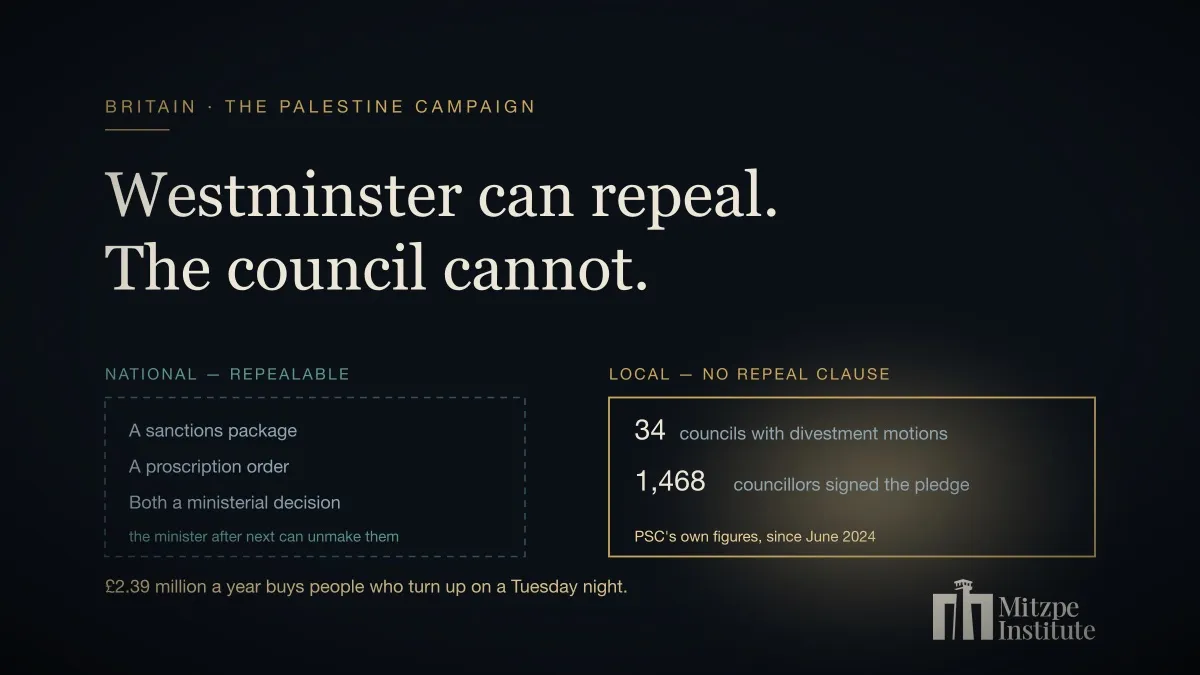
- Britain's Palestine campaign is in office
The Palestine Solidarity Campaign stopped petitioning British councils and started staffing them — 1,468 councillors signed the pledge and 34 councils carry divestment motions, and unlike a minister's sanctions package, a council motion has nobody who can unmake it.
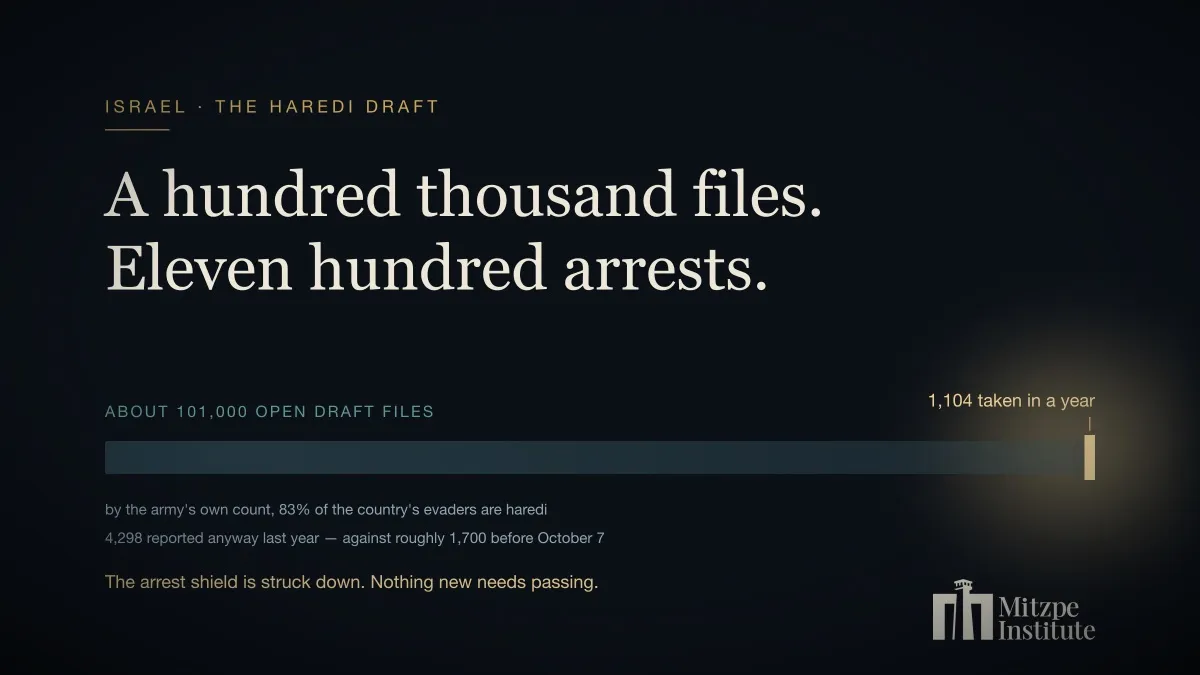
- The court left one way to draft haredi men
The High Court voided the arrest shield on 3 September, so there is no exemption law and nothing standing between an evader and an induction order — about 101,000 open files, and 1,104 men the state actually managed to take in a year.
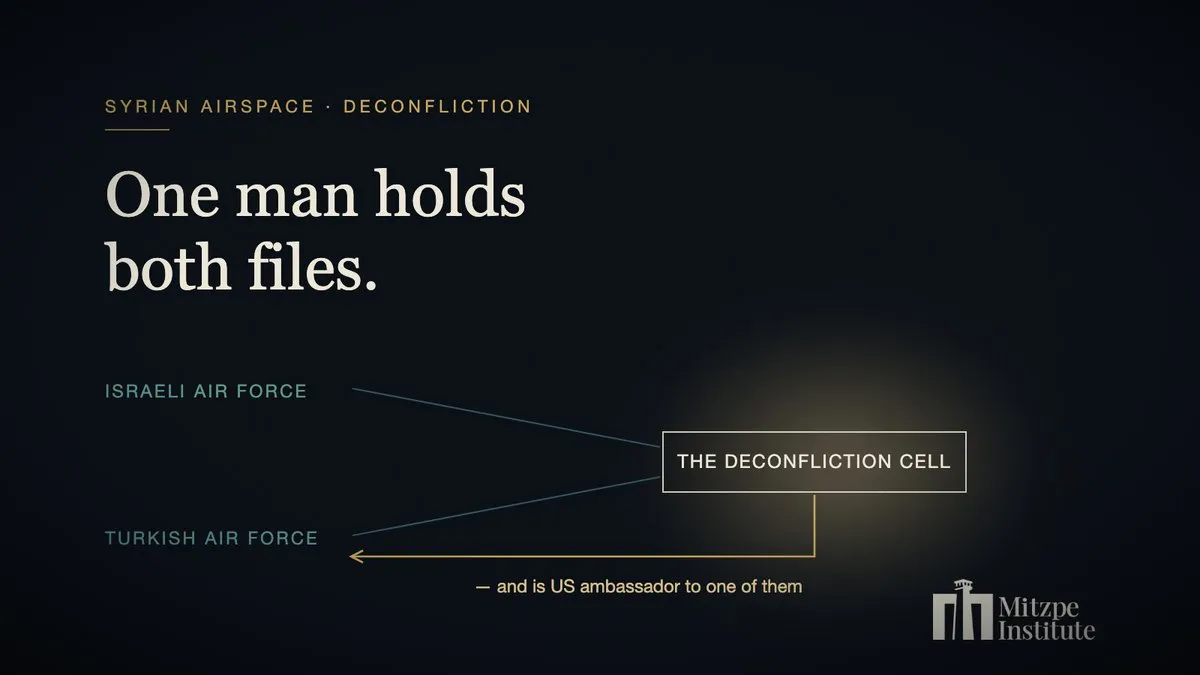
- Washington's Syria referee has a conflict
Tom Barrack is building the Israel–Turkey deconfliction cell over Syria while serving as US ambassador to Ankara — one man, both jobs, and the second represents Washington to one of the two air forces the first is meant to keep apart.
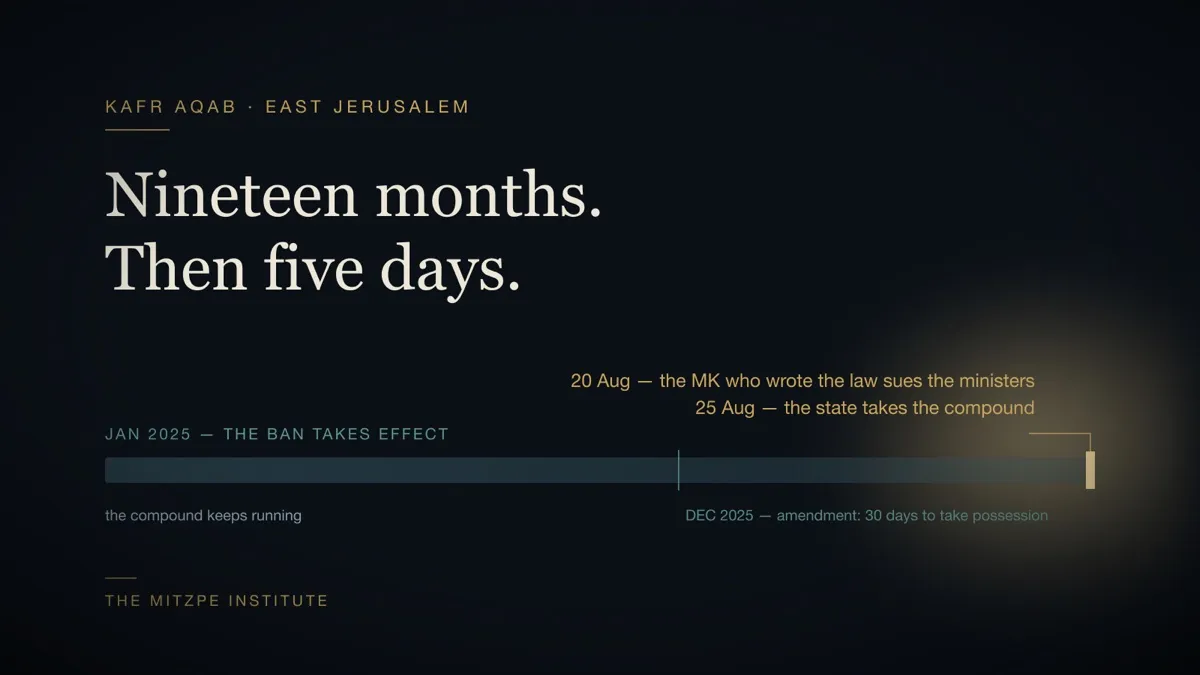
- Nineteen Months. Then Five Days.
The last UNRWA compound in Jerusalem was taken on 25 August, nineteen months after the law banning the agency took effect. What finally moved it was a High Court petition filed five days earlier — by the Knesset member who wrote the law, against the ministers who had not enforced it.
- Israel Sent Humanitarian Aid to Nepal — Why Does the Media Refuse to Report It?
Israeli and Jewish aid groups had teams moving toward the Nepal flood zone within days, and almost nobody outside a Jewish readership heard about it. The piece argues the reason is not only bias: since 1975 the UN has funded a standing apparatus whose job is to give one kind of story about Israel maximum publicity, and there is nothing on the other side built to carry this one.
- Hamas Wants to Keep Its Arsenal, Just Change the Address
Also at thealgemeiner.substack.com
Eight foreign ministries asked Washington to enforce Israel's compliance with "the Comprehensive Plan and its Road Map" — merging two texts that part company on where Hamas's weapons end up. The Comprehensive Plan puts them permanently beyond use under independent monitors; the Road Map warehouses them inside Gaza under a Palestinian committee, with an express bar on handing them to Israel. Israel agreed to the first and never to the second.
- ISIS Taught Boko Haram to Jailbreak ChatGPT
Islamic State operatives flew into Lake Chad with laptops and a projector, and taught Boko Haram's commanders how to get past the models' refusals. Every safeguard failed. What held them back was people — and people leave a payment trail. The companion to the Borrowed Fluency dossier.

- Gaza's Endgame Has Left Jerusalem
Israel won the war in Gaza. The settlement of it moved to Cairo — to a Trump-chaired Board of Peace, a UN envoy, and mediators who do not answer to Jerusalem. On disarmament passing to rooms Israel has no seat in.

- While Iran Filled the Feed, an Embassy Opened
While the cameras tracked the US–Iran deal racing toward signing in Switzerland, Somaliland's president opened an embassy in Jerusalem and almost nobody noticed. On what gets buried when one story fills the feed.
Republished elsewhere
Rooted Truth, Serialised in Full.
Guerre and Shalom ran Rooted Truth across 15 instalments. Most of them sit behind that publication's subscription. It has since been edited and republished by Mitzpe Press.
Now Guerre and Shalom is running Holiday From History the same way. The first instalment is up.
For journalists
Cite, Interview, or Request the Kit.
The analysis above traces to Israel Brief and its editor. To cite Mitzpe analysis, request an interview with the institute's principals or fellows, or receive the press kit, write to the media desk.